This is customer-facing CRM content, so I'll rewrite it in NotLuck house style.
Advanced Workflow Builder Overview
The Advanced Builder offers a fully visual, freeform canvas for creating sophisticated automations. It lets you drag, drop, and connect multiple trigger paths, parallel branches, and complex logic, all within a single view. Designed for flexibility, performance, and collaboration, it gives teams a more intuitive and powerful way to design workflows without altering how they execute.
How To Use It?
Accessing the Advanced Builder
Open any workflow and switch to Advanced Builder from the top-left corner to move seamlessly between Standard and Advanced modes within the same workflow.

Go-To Connections & Parallel Branches for Triggers
Click the "+Add" button to open the Triggers & Actions panel.

Define where each trigger should begin within your workflow, then drag a trigger's Go-To connector onto the target action.

When triggered, the workflow jumps directly to the specified action and continues execution.
Delinked Nodes (Independent or Parallel Branches)
Build non-linear branches to manage multiple triggers or outcomes within a single canvas by creating isolated clusters of actions and linking each trigger to its starting point via a Go-To connection. Each branch then runs independently within the same workflow context.
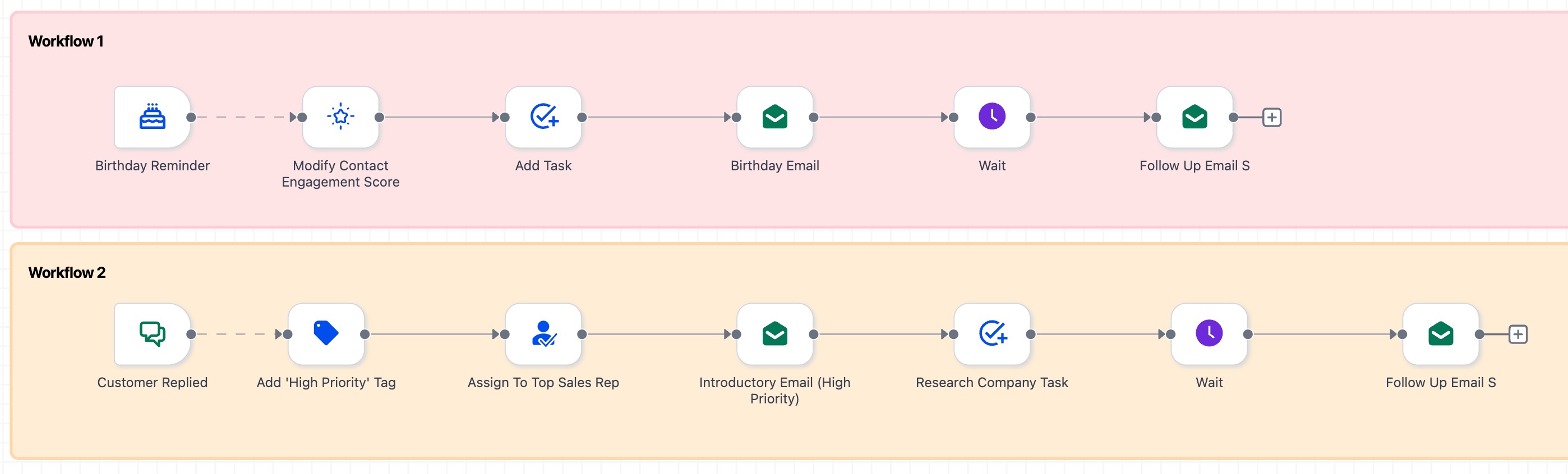
For parallel branches, you can set the default path by clicking the three-dot icon on the first action of a branch, then choosing the option to convert it to a default root action. Workflow tests and contacts entering from other workflows will then follow that path.

A solid trigger connector indicates the Default Path (1), while a dashed connector indicates a non-default path reached via a Go To connector (2).

Visual Indicators
CueMeaningSolid connectorNormal sequential pathDashed connector with arrowTrigger Go-To (jump to target action)Isolated clusterDelinked branch
Adding & Connecting Steps
Click the "+Add" button to open the Triggers & Actions panel, then select the "Add Action" option.

Here, you can configure actions directly from the panel or drag them onto the canvas.

Connect nodes by dragging from the connector handle (or the + icon).

Enable / Disable Nodes
Easily test or temporarily remove actions without deleting or rewiring connections.
- Disable: Hover over a node → click Pause.
- Enable: Hover again → click Play.
Disabled nodes are skipped during execution; connections remain intact.

You can select a set of nodes and toggle entire sections on or off from the chosen area.

Tidy Up (Auto-Layout)
Use Tidy Up to automatically organise cluttered canvases, especially after major edits or imports, for a cleaner, more readable layout.

Stats View
You can view the stats for some actions by clicking the Graph icon or switching to the Stats View Read Mode.

The builder auto-adjusts the layout for overlap to ensure all stats are visible.

Workflow Switcher
Open the Workflow Switcher from the left sidebar. Browse recent workflows or search by name/tag. Click a result to open it in a new tab, while keeping your current canvas open.

You can also create, duplicate, or delete workflows from this panel.

Tips for Efficiency
- Multi-select: Use Ctrl/Cmd + drag to move multiple nodes at once.
- Copy & Paste: Copy (Ctrl/Cmd + C) and Paste (Ctrl/Cmd + V) sections to reuse branches across workflows to replicate proven patterns.

You can access the full list of keyboard shortcuts and navigation by clicking the keyboard icon (top-left).
Notes, Limits & Best Practices
- Single enrollment per contact: Even with parallel branches, a contact cannot run through multiple branches simultaneously in the same workflow.
- Switching to Standard Builder: Remove Advanced-only elements (Trigger Go-To, Delinked Nodes, Disabled Nodes) before switching to the Standard view.
- Organise early: Use Tidy Up regularly to maintain readability.
- Name clearly: Assign descriptive names to all triggers and actions for clarity in both the canvas and Version History.
The Advanced Builder lets teams design dynamic, complex workflows visually, without sacrificing clarity or control. By combining flexible branching, streamlined navigation, and collaborative annotation tools, it makes automation building efficient, intuitive, and scalable. Use these features to bring structure, creativity, and precision to every workflow you design.